
Grand County Warrant Checks
A Grand County warrant check starts with the court named on the citation, summons, bond paperwork, or hearing notice in front of you. State cases sit with District Court or Grand County Court at the Judicial Center. Town ordinance and local traffic matters stay in the issuing municipal court. The Colorado Judicial Branch docket search for county 25 lists scheduled events, but keep in mind it is a calendar index and not an active-warrant database, and Colorado offers no single statewide warrant portal. When you search, use the full legal name, case number, citation date, and court name if you have them. A date of birth helps an official separate people with similar names, though the public docket has no birth-date field. For a personal warrant concern, a lawyer can help plan a safe appearance rather than trusting an incomplete web result.
- Read the paperwork and identify state court or a named town court.
- Search the county 25 docket by date and at least one added filter.
- Call the issuing clerk to ask what the displayed event means now.
- Use the Sheriff's targeted records request for a document it maintains.
- Contact counsel before arranging surrender, bond, payment, or a new setting.
Grand County Has No Master List
Grand County publishes no public active-warrant roster, no most-wanted list, no warrant app, and no warrant-only phone line. That gap matters. An empty docket search proves nothing. A new, sealed, juvenile, investigative, municipal, or federal matter may never surface in the state calendar, and records can change after any search.
Quick answer: confirm status with the issuing clerk. The Clerk of Court can address state-case procedure, a municipal clerk can address its own town case, and Grand County Detentions can answer current custody and bond questions.
The split is practical. The court issues and recalls warrants, the serving agency executes them, the clerk keeps the file, and Detentions handles custody and bond. No single Grand County office can certify every local warrant.
Warrants in Grand County: The Main Types
Why a warrant was issued shapes where to confirm it and how it can be resolved. Colorado uses bench warrant and failure to appear for missed duties. Grand County does not use the phrase capias pro fine as local terminology.
| Warrant Type | How It Arises | Who Issues It |
|---|---|---|
| Arrest warrant | A sworn complaint or affidavit supports probable cause. | An authorized Colorado judicial officer |
| Bench warrant | A person misses court or a court-ordered duty. | The judge responsible for the case |
| Search warrant | Probable cause supports a search for specified evidence. | An authorized judge or magistrate |
| Municipal FTA warrant | A town citation or appearance stays unresolved. | The issuing municipal court |
A warrant is separate from the charge beneath it. Paying a fine or posting bond does not dismiss that charge. Get any recall or quash order confirmed in writing, since a receipt alone may not show whether a warrant is still live.
County 25 Docket Search Fields
The official docket interface lets you filter by location, court, date range, a specified date, case-number parts, case class, party, and attorney, and it demands at least one filter beyond the date. Searching a bare name over the wrong date span can miss an event. The printable result view organizes the event labels in one layout. The county 25 search interface supports a preliminary case check, not a promise about present warrant status.
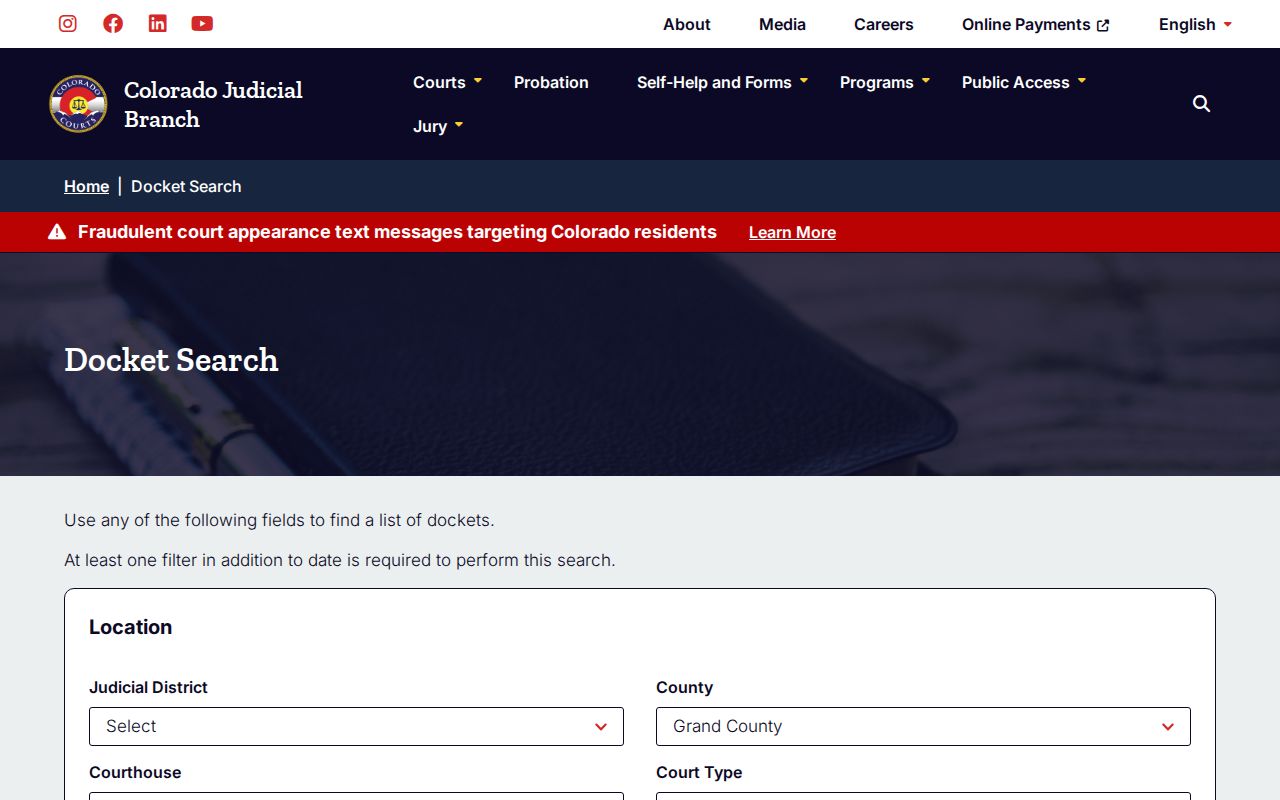
Write down the exact court, case number, date, and event text before calling the clerk. Those details separate a scheduled hearing from a live Grand County warrant.
| Public field | Useful for | Not shown |
|---|---|---|
| Date and court | Finding an event | Active or recalled toggle |
| Case number parts | Narrowing to one file | Warrant number |
| Party or attorney | Finding a listed case | Birth date and bond amount |
Grand County Warrant Records: What They Show
A complete warrant record can hold facts the public docket never shows. The originating file may name the person, the alleged offense, the issuing authority, dates, bond terms, and disposition. Access depends on which office holds the file and its status. Grand County publishes no local warrant-number pattern, so do not assume one.
| Case reference | A state case number may use year, class, and sequence parts. |
|---|---|
| Subject | The legal name; officials may use birth date to distinguish similar names. |
| Allegation | The charge, ordinance, or missed duty tied to the process. |
| Issuing court | District, County, or municipal court with authority. |
| Bond | The current type or amount, if any, needs official confirmation. |
| Status | Active, served, recalled, or quashed, subject to a current check. |
The docket may label an event Appearance on Arrest Warrant or Appearance on Bond. Those are calendar entries. They do not expose the warrant, affidavit, service date, signature, or live status.
Grand County Docket Labels Need Context
The printable layout shows why a result needs careful reading. It groups hearings and event labels rather than rostering people with warrants, and no party rows are reproduced here. A hearing can stay visible in Grand County after service, a bond decision, or another change.
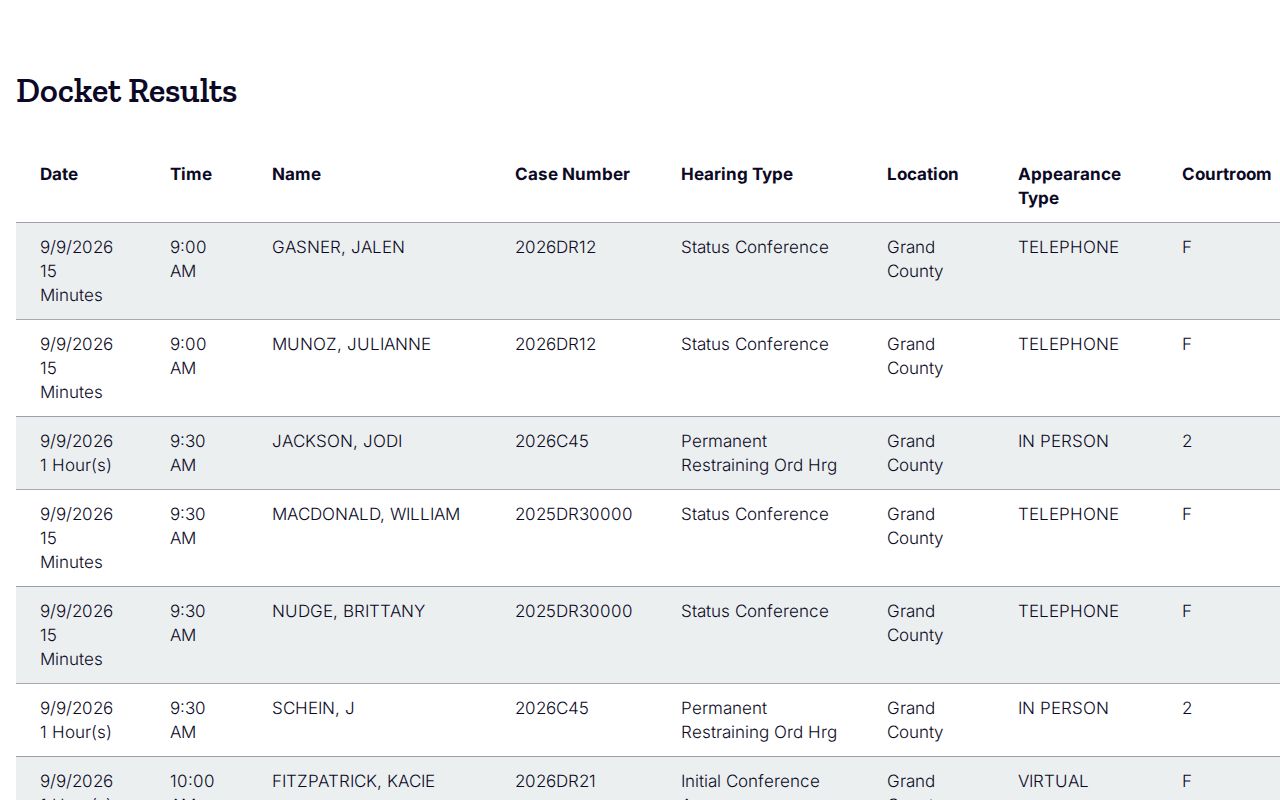
Treat no event found as a search result, not a clearance certificate. Ask the clerk whether the Grand County warrant is active, served, recalled, or set aside. If the court acted, get written proof and keep it with your receipt.
- Recall
- The court withdraws its warrant.
- Quash
- The court sets the process aside.
- Served
- The warrant has been executed.
- FTA
- Failure to appear at a required setting.
Grand County Warrants: Who Issues, Who Serves
Grand County belongs to Colorado's 14th Judicial District alongside Moffat and Routt counties. District Court handles felonies, while Grand County Court handles state traffic, misdemeanor, and petty matters, and municipal courts take their own ordinances and local traffic cases. The courts authorize warrants; the Grand County Sheriff and other peace officers may serve them. The Communications Center coordinates listed agencies but is not a public warrant database. The official judges and staff page identifies court contacts for the state route.
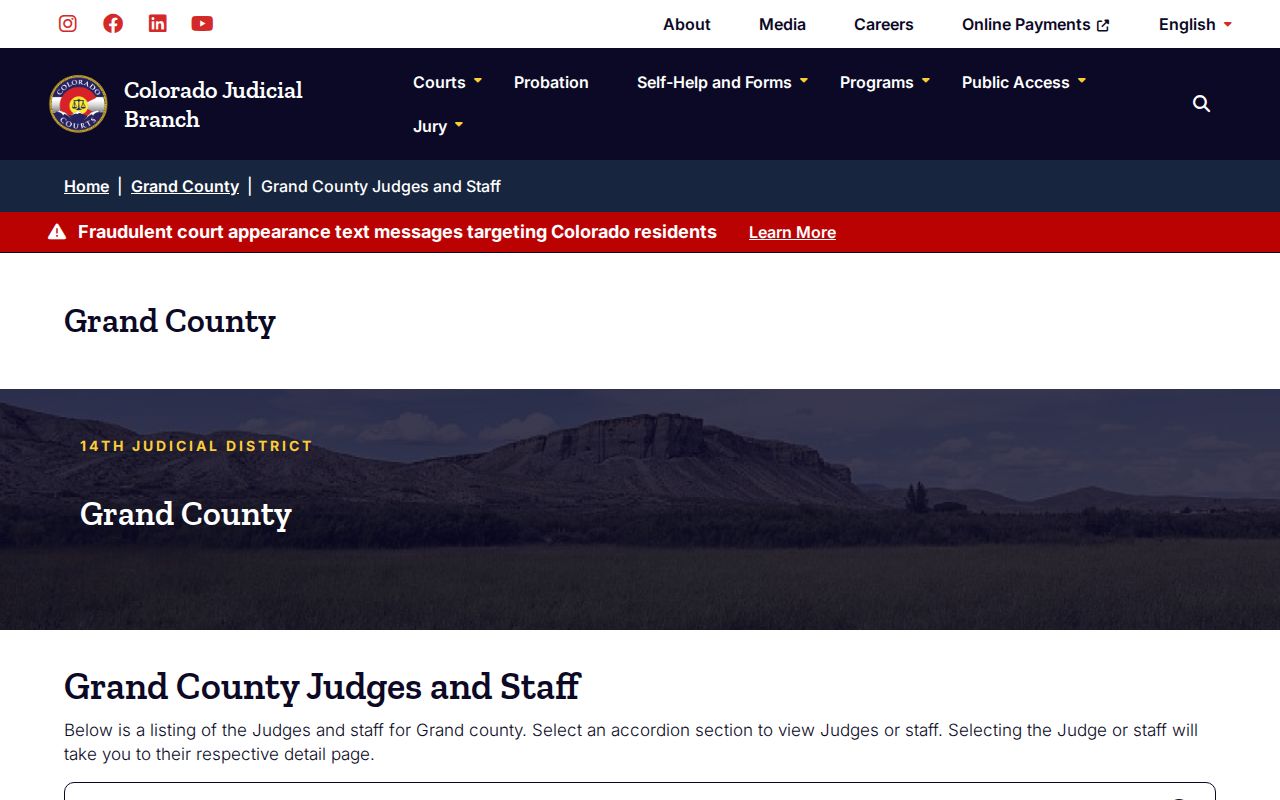
That page gives contacts but no public bench-warrant lookup. For a court copy, call the Grand County court about its file, not the jail.
Grand County Sheriff's Office
670 Spring Street
Hot Sulphur Springs, CO 80451
970-725-3343
Grand County Judicial Center
307 Moffat Avenue
Hot Sulphur Springs, CO 80451
970-725-3357
Grand County Records Request Fallback
Grand County posts no instant warrant checker, so the Sheriff's criminal-justice-records route is a written request. The records request form asks for your contact and address details, then the subject's name and birth date, a case number, the incident location, the request date, and a narrow description of what you want. You can get the documents by mail, in person, email, or fax, and Records Management wants photo identification with separate requests. Fees depend on which Grand County page governs your request. The records page charges $5 for up to ten pages and $0.25 for each added page, and many requests finish within three business days. A printable form lists time-based prices for incident reports and media, while the transparency page offers a first hour free, then $30 per hour or $0.25 per standard page. None of these quotes a warrant-status price. Ask about charges before you submit.
A request may be denied, redacted, delayed, or routed. It does not force the Sheriff to create a current warrant-status report.
Handling a Grand County Warrant
An online result should never be the whole plan. A Colorado attorney can call the issuing court, see whether a counsel-arranged appearance fits, and explain the charge behind the warrant. The clerk walks you through filing and calendar steps but gives no legal advice. Grand County offers no safe-surrender window, amnesty event, warrant motion form, or walk-in guarantee.
- Confirm the court and case number from official papers or the clerk.
- Ask whether the process is active and what the judge requires.
- Discuss surrender, recall, quash, reset, or bond with counsel.
- If in custody, call Detentions for current bond type and amount.
- After court action, obtain the order and verify each system updated.
Do not pay an unexpected caller. Use official court and Sheriff contacts. Payment, bond, and recall are separate acts.
Grand County Detentions allows personal-recognizance, surety, cash, and remote bonding. Remote bond runs around the clock, but call first. A judge may depart from the 14th District schedule, and serious categories need a judicial decision.
Grand County Bond Route After Arrest
The Grand County jail holds 50 adult beds and posts a bond contact, though it publishes no warrant roster. Call 970-725-3343 and ask for the jail to learn the current bond amount and type. A personal-recognizance bond is simply a signed promise when granted. Surety goes through a licensed bondsman, and cash means the full amount in whatever form the Sheriff directs. Order 24-02 supplies the 14th Judicial District bond schedule for Grand, Moffat, and Routt. It lets certain bonds be accepted when no judge is available, but that permission is presumptive rather than guaranteed. Judges may deviate, and listed serious categories always require one. The order also describes a limited hold while an order is sought and a probable-cause decision within the legal time frame.
Fee language shifts, so confirm it before you pay. The jail page and the posted rights notice differ. In Grand County, ask for the notice, keep a receipt, and take bond-return questions to the court.
Warrant Record Access Under Colorado Law
Colorado sets the rules for access. The Colorado Criminal Justice Records Act governs criminal-justice records held by covered agencies, while the Colorado Open Records Act covers general public records. Trial-court files follow Judicial Branch access rules. None of these laws makes every Grand County affidavit, juvenile file, sealed case, or active investigation an open online record.
Key access rules:
- C.R.S. §§24-72-301 through 309 govern criminal-justice records and include limits.
- The court access guide separates docket search from court documents.
- CORA requests belong with the custodian holding a general county record.
- Sealed, juvenile, protected, investigative, and unfiled material may be withheld.
Ask the Grand County office which agency owns the file, the basis for withholding, the fee, and the response estimate. A commercial search result is not an official copy.
Grand County FTA Data Is Not Warrants
One official report for Grand County location 25 showed 3,630 scheduled events, 299 failures to appear, and an 8.24 percent FTA metric in its reporting period. Those numbers count court events and a rate. They are not an active-warrant count or roster. After a failure to appear, a judge may grant an extension, reset the matter, enter another default, or act in another way.
Grand County is large and thin. The 2020 Census counted 15,717 residents across 1,875 square miles, and county emergency planners describe more than one million annual guests. One state courthouse, the jail, shared dispatch, and separate municipal custodians cover that spread.
Virtual Court Is Not Appearance
Colorado Judicial publishes livestream and virtual-court information, but watching a livestream is not appearing. For a valid remote or in-person appearance, follow the court's own directions. That warning matters most when a missed setting could trigger a bench warrant. Hours need the same care. The Judicial Center location page lists weekday hours with a noon closure, while the trial-court page showed shorter temporary clerk hours. Call 970-725-3357 before you travel. Sheriff's business hours differ from court hours, and a Grand County jail bond question belongs with Detentions, while a court-file or reset question belongs with the clerk.
A video stream is not permission to miss court. Confirm the assigned room, time, and method with the issuing court.
Grand County Sheriff Is Not a Roster
The Grand County Sheriff's overview names Judicial Services, Detentions, and Communications, but the office posts no public active-warrant or most-wanted list. Skip third-party rosters that claim to fill that gap. The official page shows the Sheriff's available navigation.
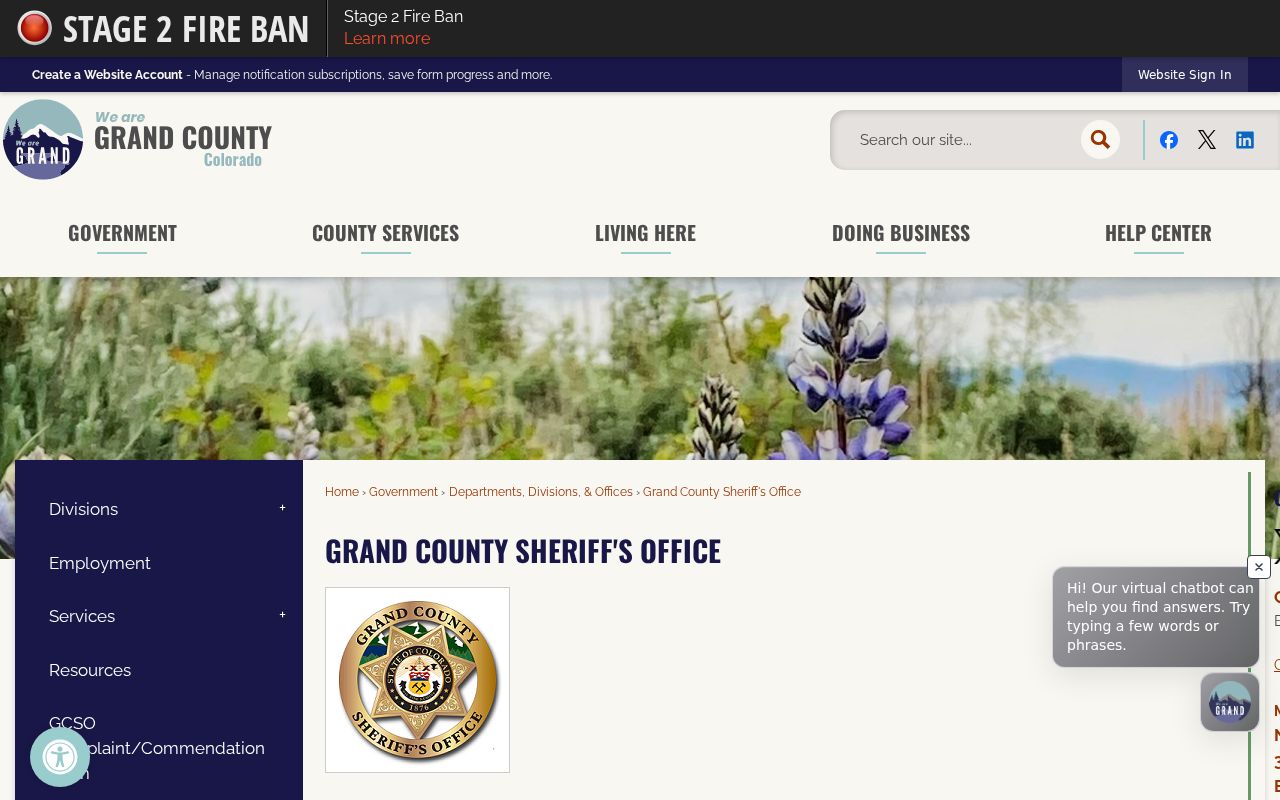
For your own record, request a narrow document from the Grand County Sheriff. For custody or bond, call Detentions. For state-court status, use the clerk. Call 911 only for an emergency. Never approach a person based on a web claim. The Sheriff reports serving Grand County since 1874, with 63 employees and six divisions, and none of that says how many warrants it holds.
Six Grand County Citation Paths
Grand County's six municipal governments each run their own route. Granby takes traffic, parking, animal, and code cases. Kremmling offers a court and clerk route. Fraser and Winter Park share one court and police department. Grand Lake keeps a separate Town Hall court. Hot Sulphur Springs has a verified town route, but no complete current public municipal warrant portal.
| Paperwork says | Start here | Confirm with |
|---|---|---|
| County or District Court | County 25 docket | Grand Clerk |
| Granby or Kremmling | Municipal clerk | Issuing town court |
| Fraser or Winter Park | Shared clerk | Town box on citation |
| Grand Lake | Grand Lake court | Town or Sheriff as cited |
| Hot Sulphur Springs | Town clerk | State clerk or Sheriff |
A payment portal is not a general Grand County warrant lookup. Verify it takes that citation, then ask whether payment, a court setting, or a recall is still needed.
City Warrant Records in Grand County
The five largest incorporated places in the 2020 Census take distinct routes in Grand County. Each keeps municipal court, police, payment, and fallback facts separate.
Grand Lake stays a sixth municipal route beyond the top five. Its Town Hall court handles town matters in Grand County and routes Sheriff's citations back to the Sheriff.